
How to Write Engaging Blogs That Hold Readers for 5+ Minutes
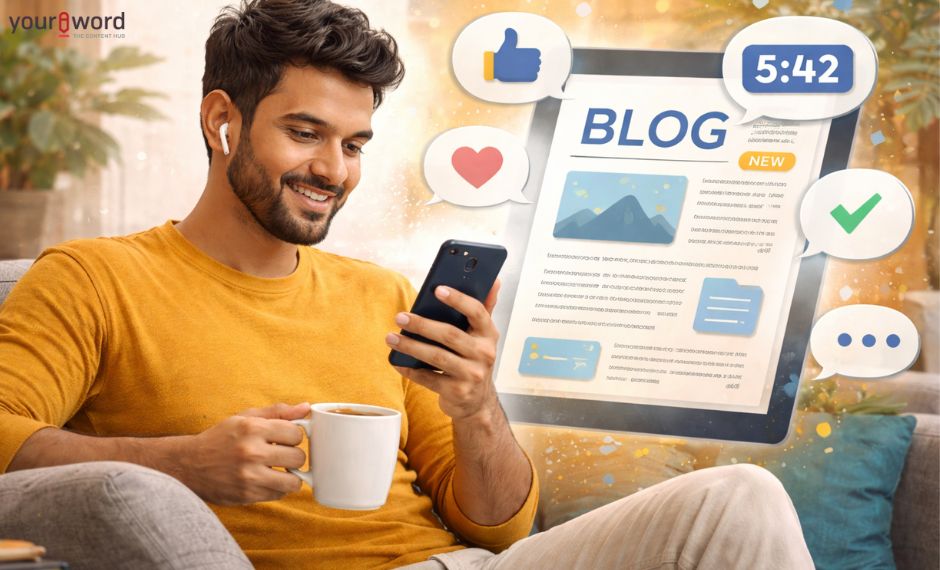
Everyone is so glued to their phones that any free or leisure time becomes dedicated to watching reels or just spending time on their device. Nowadays, people are so hooked on reels and short videos that their attention span is decreasing to a great extent. It’s like before, it was movies; then we switched to short videos lasting 20 to 30 minutes. But these days, reels are the trend, and they come in under 2 minutes. People are now such constant consumers that their attention span is decreasing day by day.
People are constant consumers, often taking in different types of content at the same time. Even when on a social media platform watching something informative, they may quickly switch to something commercial. The reels are so interesting and attractive, with their compelling visuals and sounds. Just imagine trying to keep a reader engaged for more than five minutes. The best key to holding their attention is to start with a hook or a relatable scenario something that makes the reader curious to know what’s next.
Yourword is a leading content writing agency in Kerala that specializes in blog writing. In this article, we will explain how to write engaging blogs that hold a reader's attention for at least 5 minutes.
How to master the golden first scroll?
Think of a reader landing on a blog page just by chance. The term "Golden First Scroll" refers to that initial moment before the reader decides to scroll down. This is like window dressing: customers are persuaded to either buy things or walk into the store just by what they see. Likewise, for a blog, you only have a moment to make them stop, look, and decide to stay. There are certain ways to attract and hook readers in that moment. Let's see what they are.
1. Your headline is the highlight with bold sign
The first instance should naturally create an eagerness to read. You can create this by sparking curiosity and by making the content specific. Most importantly, it should clearly signal to the reader that reading it will be beneficial.
Creates Curiosity: It makes the reader wonder "How?" or "Why?"
Specific: It promises a clear, tangible outcome. "7 Ways to Bake Bread" is okay. "The 7-Ingredient No-Knead Bread That Always Works" is better.
Shows a Benefit: It answers the reader's silent question: "What's in it for me?" Use words like "easy," "fast," "proven," or "secret" to highlight that benefit.
2. Step inside invitation
To engage readers effectively you should begin with a direct statement to address the main heading immediately. For example, if you are discussing a problem the root cause and alternative solution is needed, just when dough is dense the solution is to allow it to rest and then the dough will rise and become fluffy. In content also fluff that delays addressing the issue, as it may cause readers to lose interest.
3. Visual Anchors are the key for attraction
It is understandable that a large block of content can be intimidating. Therefore, it is essential to capture attention by adding a relatable picture one that brings creativity, colour, and interesting elements to the page.
Blogs can be structured in different ways by mixing formats within the same post. This includes using bullet points, subheadings, short paragraphs, explanations in chronological order, and numbered lists for steps or procedures.
The headline grabs them, the first lines prove you understand them, and the visual promise makes the content look easy and rewarding to consume. You've just taken them from a casual browser to a committed reader in under 15 seconds.
4. How to structure the blog with Readability and depth?
Rather than a textbook or magazine, the blog posts people will be reading from either through any devices mobile and laptop. It is always a guide for different insights that includes transactional, navigational, commercial, and informational. Let’s see how to structure the blog in terms of content and terminology.
- Inverted Pyramid:
When writing blogs don’t bury the stuff, it is recommendable to start with a hook and in the introduction it should be able to give the summary or plot of the whole blog. Then it in the following section it should be broken to simpler forms, explaining all aspects inducing why, where, when including different types relating to the main topic. That the solid and core content should be articulated in an interesting way so that they can easily adapt.
- Subheadings as Map:
A person scanning should be able to read *just* your subheadings and understand the journey of your article.
- Strategic formatting in content:
The content can be readable and interesting to read by strategic formatting using bulletin points, bold key phrases, short paragraphs.
- Bulletin points are best for steps, features, or examples. It is because the brain loves list.
- Highlight bold key phrases to ensure the scanner's eye catches the most important sentence in a paragraph.
- The "Iceberg Method" suggests catering to both scanners and deep readers by using a structured layout with headlines, subheadings, bolded text, lists, and images. This approach provides quick, scannable information that allows readers to grasp 80% of the content's value in just 30 seconds.
Imagine you are a business owner with a website. Nowadays, simply owning a website is not enough. it needs to be worked on continuously. To keep your online presence active, you should post blogs regularly. However, not all tips are going to work for every topic. The type of content, the target client, and the heading must all resonate equally with what the blog truly needs. If you are someone one looking for professional writers, then yourword is an ultimate choice. Yourword promises the best Blog writing services that helps to keeps people from just scanning the signs and actually reading all the displays.
What We Offer
Web Content Development
SEO Based
Content Writing
Brand Identity Creation
Translation services
Content Marketing
Let’s talk about how
Your Word can help you.
Services
Contact
-
Your Word The Content Hub
2nd Floor, Calicut Business Center
Kallai, Kozhikode, Kerala, India - 673003 - +91 984 741 1117
- [email protected]

Copyright ©2026 Your Word. All Rights Reserved. Developed by 